


| Power washing in Delaware typically costs between $0.30 and $0.80 per square foot, with most homeowners paying $250 to $800 depending on the service. House washing ranges from $250 to $1,300, driveway cleaning runs $100 to $500, and roof cleaning costs $500 to $2,000. Your final price depends on your home’s size, surface material, condition, and how many services you bundle together. |
What Does Power Washing Cost in Delaware? (Service-by-Service Breakdown)
The fastest way to understand pricing is to see what each service actually costs. The table below reflects real Delaware market rates, not national averages pulled from a generic database.
| Service | Delaware Price Range | Avg. Time | Key Pricing Factors |
| House Washing (1-Story) | $250 – $350 | 1.5 – 2 hrs | Size, siding type, dirt level |
| House Washing (2-Story) | $400 – $800 | 2 – 3 hrs | Height, peaks, ladder access |
| House Washing (Large/Estate) | $800 – $1,300 | 3+ hrs | Complexity, multiple stories |
| Roof Cleaning | $500 – $2,000 | 1.5 – 2 hrs | Pitch, material, age, condition |
| Driveway Cleaning | $100 – $500 | 45 min – 1 hr | Size, surface type, staining |
| Gutter Cleaning | $150 – $600 | 1 – 2 hrs | Length, stories, debris level |
| Window Cleaning | $500 – $1,000 | 1.5 – 4 hrs | Number of windows, type, access |
| Deck Cleaning | $150 – $700 | 45 min – 3 hrs | Material (wood vs. composite), size |
| Solar Panel Cleaning | $200 – $600 | 1.5 – 2 hrs | Number of panels, roof access |
These ranges come from what we see across Delaware, from the inland communities around Dover to the coastal properties in Lewes and Bethany Beach. Every property is different, which is why we provide free on-site estimates rather than quoting over the phone based on Zillow square footage alone.
National averages from sources like HomeGuide often show lower numbers because they factor in markets with lower labor costs, less humidity, and less organic growth. Delaware’s climate pushes real-world pricing higher than those benchmarks.
Power Washing Prices by Area: Coastal vs. Inland Delaware
Not every part of Delaware costs the same to clean. Coastal towns like Rehoboth Beach and Bethany Beach deal with salt air, higher humidity, and accelerated oxidation that inland communities do not face. Homes near the coast also tend to use hardie board siding, which requires gentler, more time-intensive soft washing compared to the vinyl siding common in inland towns.
The table below shows how house washing and driveway cleaning prices shift depending on where you live in Sussex County and the surrounding areas.
| Area | House Wash (2-Story) | Driveway Cleaning | Roof Cleaning | Why Prices Differ |
| Georgetown | $350 – $600 | $100 – $350 | $500 – $1,200 | Mostly vinyl, standard cleaning needs |
| Milton | $375 – $650 | $100 – $350 | $500 – $1,300 | Mix of vinyl and hardie board |
| Millsboro | $350 – $600 | $100 – $350 | $500 – $1,200 | Inland location, similar to Georgetown |
| Lewes | $450 – $750 | $150 – $400 | $600 – $1,500 | Coastal salt air, more hardie board |
| Rehoboth Beach | $500 – $800 | $150 – $450 | $650 – $1,800 | Heavy salt exposure, larger homes |
| Bethany Beach | $500 – $850 | $150 – $450 | $650 – $2,000 | High salt air, hardie board dominant |
| Ocean View | $450 – $750 | $125 – $400 | $600 – $1,500 | Coastal-adjacent, mixed siding |
| Fenwick Island | $500 – $850 | $150 – $450 | $650 – $1,800 | Direct oceanfront exposure |
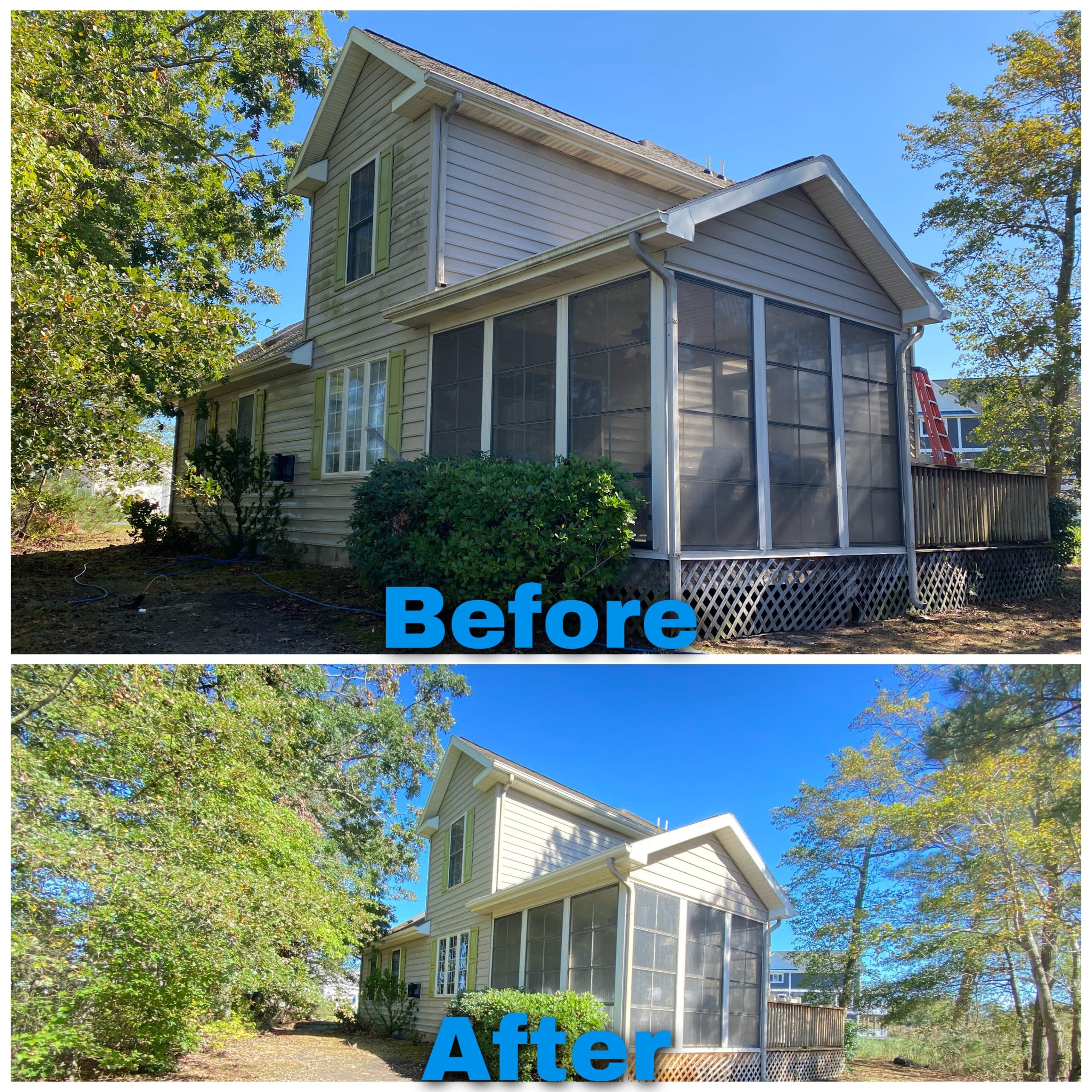
Georgetown and Millsboro homeowners typically land on the lower end of these ranges. Most homes in these inland communities have vinyl siding, which cleans faster and requires less specialized technique. The buildup tends to be standard algae and pollen rather than the salt-driven corrosion and oxidation we see at the coast.
Rehoboth Beach, Bethany Beach, and Fenwick Island sit at the higher end for two reasons. First, salt air accelerates oxidation on siding and causes buildup to return faster, which often means heavier contamination at the time of cleaning. Second, hardie board is the dominant siding material in these beach communities, and it requires careful, low-pressure soft washing to avoid scratching the surface. That extra care takes more time and more product.
Lewes and Ocean View fall somewhere in between. They catch enough coastal influence to push prices above inland rates, but the homes are not as uniformly large or salt-exposed as direct beachfront properties.
These ranges assume a standard-sized home in average condition. Your actual quote depends on the specific property. We serve all of these communities and provide free on-site estimates so you get a price based on your home, not a zip code average.
What Factors Affect Power Washing Prices in Delaware?

Six variables determine what you will pay. Understanding them helps you anticipate your quote before a contractor ever arrives.
Property size is the most obvious factor. A 1,200-square-foot ranch costs less than a 3,000-square-foot colonial because it requires less cleaning solution, less water, and less time.
Surface material dictates the technique. Vinyl siding can handle moderate pressure, so the process is straightforward. Hardie board, which is common near Delaware’s beach communities, requires much gentler treatment. Once hardie board starts oxidizing, too much pressure will scratch and damage the surface. Stucco needs a high-concentration cleaning solution with minimal pressure. Brick demands careful technique to avoid eroding the mortar between joints.
Contamination level makes a significant difference. A home with light dust and pollen is a faster job than a home with years of green algae packed into every crevice. Heavy mold, oxidation, or oil stains on driveways may require multiple treatment passes and specialty chemicals, adding $50 to $150 to the base price.
Number of stories affects both time and safety requirements. Two-story homes require ladders, sometimes harnesses, and additional crew members. High peaks and dormers add complexity.
Your location within Delaware matters. Coastal properties in Lewes, Rehoboth, Bethany Beach, and Ocean View face accelerated wear from salt air. The salt corrodes surfaces faster and causes oxidation to develop sooner, which means more intensive cleaning.
The condition of surrounding areas can factor in too. If we need to protect fragile landscaping, navigate tight access points, or work around features like solar panels or outdoor furniture, those details get factored into the estimate.
Power Washing vs. Soft Washing: Which One Do You Need?
These two methods solve different problems, and the right choice depends on the surface being cleaned.
| Factor | Power Washing | Soft Washing |
| Pressure Level | High (2,000 – 4,000 PSI) | Low (under 500 PSI) |
| Best For | Concrete, driveways, sidewalks, pavers | Siding, roofs, delicate surfaces |
| Cleaning Method | Water pressure removes buildup | Cleaning solution kills growth at the root |
| Cost per Sq Ft | $0.30 – $0.60 | $0.40 – $0.75 |
| Risk of Damage | Higher on delicate surfaces | Minimal when done correctly |
We use both methods and adjust based on what each surface needs. Concrete driveways get power washed with a surface cleaner that spins at high pressure for even, thorough results. Your vinyl siding gets soft washed with an eco-friendly cleaning solution (sodium hypochlorite at a controlled, low concentration) that kills algae and mold at the root rather than just blasting it off the surface.
Soft washing costs slightly more per square foot because the cleaning solutions are the active ingredient, not just water pressure. But the results last longer because the treatment kills organic growth rather than simply displacing it.
The Power Washers of North America (PWNA) recommends matching the cleaning method to the surface material, which is why a company that uses only one technique for every job should raise a red flag.
What Does a Professional Power Washing Service Actually Include?


The price you pay covers more than someone pointing a pressure washer at your house. A professional service follows a multi-step process designed to clean thoroughly without causing damage.
For a house wash, our crew arrives, notifies you that we are on-site, and begins setting up equipment. We connect to your water source, prepare our cleaning solutions, and start by applying a pre-treatment detergent to the entire surface. That solution needs time to dwell and break down organic growth. While it works, we handle secondary tasks like window rinsing or gutter brightening if those are included in your service.
After the dwell period, we rinse everything, working section by section to remove dead algae, mold, and grime. We spray a neutralizing agent called Plant Wash on all landscaping to protect your plants, shrubs, and grass from any cleaning solution runoff. We also adjust our solution ratios based on the weather. Hot days require less chemical concentration, while cooler temperatures need a slightly stronger mix to achieve the same results.
Service Tiers: Basic, Deluxe, and Premium
Not every house wash is the same job. We offer three tiers so you can choose the level of cleaning your home needs.
Basic House Wash covers the essentials: cleaning detergent application, a thorough rinse, window rinsing, and washing of the foundation and porches. This is the right choice for homes with light to moderate buildup that get washed regularly.
Deluxe House Wash adds gutter scrubbing to remove black streaking and hard contamination that builds up over years of neglect. It also includes detailed window cleaning with a dedicated cleaning solution rather than a simple rinse.
Premium House Wash includes everything in the deluxe tier plus siding scrubbing to remove oxidation and a protective coating applied after the wash. That coating helps slow future buildup so your home stays cleaner longer between washes.
The tier you choose directly affects your final cost, but it also affects how long the results last and how your home looks when we leave.
How to Save Money on Power Washing in Delaware
You do not have to pay full price for every service if you plan ahead.
Bundle multiple services on the same visit. If we are already on-site for a house wash, adding driveway cleaning or gutter cleaning costs less than booking each service separately. We are set up, our equipment is running, and adding a service takes less incremental time than a standalone appointment.
Schedule after pollen season peaks. Delaware’s pollen season runs from February through November, with the worst months being April through June. Booking your house wash in late May or June means the cleaning lasts longer into fall and winter because the heaviest pollen has already passed.
Ask about military and veteran discounts. We offer up to 15% off for active duty military and veterans.
Keep up with annual maintenance. A home that gets washed every year accumulates less buildup than one that goes three or four years between cleanings. Less buildup means a faster job, which means a lower price.
Watch for seasonal promotions. We typically run specials at the start of the spring season, such as $100 off when you book two or more services together.
How Often Should You Power Wash Your Delaware Home?
Delaware’s climate is harder on exterior surfaces than many homeowners realize. The state averages 45 inches of rainfall per year with average humidity between 73% and 77%. Summer months regularly exceed 80% humidity. That constant moisture feeds algae, mold, and mildew growth year-round.
| Service | Recommended Frequency | Why It Matters in Delaware |
| House Washing | Once per year | Humidity and pollen cause faster buildup |
| Roof Cleaning | Every 2 – 3 years | Proper soft wash can last 3 years with warranty |
| Gutter Cleaning | Twice per year | Heavy tree coverage increases debris |
| Driveway Cleaning | Every 1 – 2 years | Algae and oil stains worsen with moisture |
| Window Cleaning | 1 – 2 times per year | Schedule after pollen season for best results |
| Deck Cleaning | Once per year | Wood decks need annual care to prevent rot |
We are one of the few Delaware companies that guarantees our roof cleaning results for three years. Most companies will not offer that commitment because their process does not kill growth at the root. Our soft wash method, combined with proper solution concentration and thorough coverage, eliminates algae so completely that regrowth takes years rather than months. Check out our power washing frequency blog post to learn more.
For gutter cleaning, the general recommendation is twice a year, but homes surrounded by trees may need it more often. The simplest rule: if you see overflow during a rainstorm, call us.
Is Power Washing Worth the Investment?
A $300 to $700 house wash is one of the highest-ROI maintenance investments a Delaware homeowner can make.
Real estate industry data consistently shows that pressure washing can increase a home’s perceived value by 5% to 10%. With Delaware’s median home value sitting at roughly $398,000 (as of April 2026), that translates to $19,900 to $39,800 in perceived value from a service that costs a fraction of that.
Beyond resale value, regular exterior cleaning prevents expensive repairs. Algae left on a roof accelerates shingle deterioration. Mold on siding can lead to rot that requires full panel replacement. Neglected driveways develop permanent staining that no amount of cleaning can fully reverse. A $500 annual wash is far cheaper than a $5,000 siding repair or a $15,000 roof replacement.
Delaware homeowners in HOA communities face an additional incentive. Many HOAs require regular exterior maintenance, and homes with visible mold streaks, stained driveways, or dirty siding can receive violation notices and fines. Keeping a regular cleaning schedule prevents those headaches entirely.
Frequently Asked Questions
What is the difference between power washing and pressure washing?
Power washing uses heated water, which breaks down grease, oil, and heavy grime more effectively. Pressure washing uses cold water at high pressure. In practice, many contractors use the terms interchangeably. We use both hot and cold water depending on the job. Hot water is particularly effective on commercial properties with grease buildup, while cold water pressure washing handles most residential surfaces well.
Can power washing damage my home?
Incorrect technique causes damage, not the method itself. Too much pressure on hardie board or stucco gouges the surface. Too much pressure on shingle roofs can void the manufacturer’s warranty. We provide material safety data sheets to customers who want to understand exactly what products we use, and we adjust our pressure, nozzle selection, and chemical concentration for every surface we clean. That attention to detail is what prevents damage.
What time of year is best for power washing in Delaware?
Late spring through early fall works best. Many of our customers schedule their house wash in late May or June after the worst of Delaware’s pollen season has passed. This timing gives you the longest stretch of clean exterior before the next pollen season starts. We do not recommend washing during freezing temperatures because residual water can ice on surfaces and create hazards.
Should I power wash my house before selling it?
Yes. It is one of the most cost-effective improvements you can make before listing. A clean exterior signals to buyers that the home has been well maintained, which directly influences their willingness to pay full asking price. Real estate agents consistently rank curb appeal as one of the top factors in a successful sale.
Do I need to be home during power washing?
For exterior-only services like house washing, driveway cleaning, and roof cleaning, you do not need to be present. We notify you when we arrive, complete the work, and follow up with confirmation when everything is done. If your service includes interior window cleaning, someone will need to provide access. We send reminders before your scheduled date and contact you about an hour before arrival so you know when to expect us.
Get Your Free Delaware Power Washing Estimate
Every property is different, and the only way to get an accurate price is a walkthrough. We provide free, no-obligation estimates where we assess your home’s size, surface material, and condition in person. No guesswork, no inflated Zillow-based quotes.
Call us at (302) 228-6599 or visit ortizprowash.com to request your estimate today.